


Written by Dr Siân Shaw, Associate Professor Digital Innovation in Nursing at Anglia Ruskin University, this blog showcases Anglia Ruskin University’s Health@Home Hub (H³) as a leading example of how universities can prepare future healthcare professionals for a rapidly expanding, home‑first digital care system through immersive, practice‑based learning. The blog highlights how H³’s real‑world partnerships, lived‑experience co‑design, and staff development create an authentic, scalable model for delivering impactful digital‑health education and driving wider healthcare transformation.
The transition from analogue to digital care is a central pillar of the Government’s ambition to reform the NHS. For universities, this presents both a significant opportunity and a pressing challenge: how to ensure that future healthcare professionals are confident, competent and creative users of digital technologies, while also preparing them for a system that is rapidly shifting care from hospitals into homes and communities.
Digital innovation is already embedded across healthcare curricula, but as technologies advance, universities must move beyond theoretical teaching towards experiential, practice-based learning. This requires not only new infrastructure, but new partnerships, investment, and staff development models that enable academics to translate digital innovation meaningfully into the classroom.
Collaboration as the Catalyst for Change
Preparing students for this changing landscape cannot be achieved by universities working in isolation. Strategic partnerships with industry, communities, and those with lived experience are essential. Anglia Ruskin University’s Health@Home Hub (H³) demonstrates what is possible when these elements align.
H³ is built on a simple but powerful premise: if care is increasingly delivered at home, then education, research and innovation must also take place in environments that reflect that reality.
From Vision to Reality: A Living Lab for Home-First Care
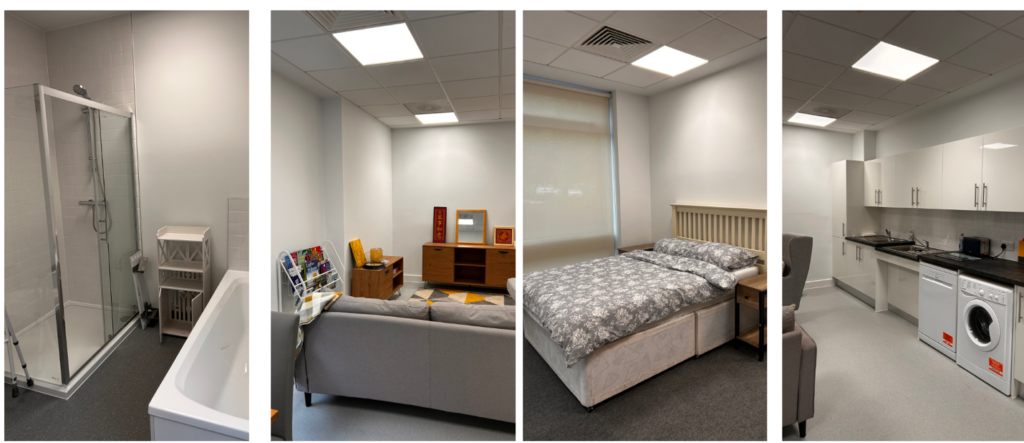
H³ is now fully operational as both a physical and digital space. The flat is complete, the technology installed, and the infrastructure live. Designed as a realistic, fully furnished home, the hub integrates Internet of Things (IoT) sensors, telecare and remote monitoring systems, telehealth platforms, and live digital dashboards.
This is not a simulation in name only. H³ mirrors the environments where care increasingly takes place: people’s own homes. Students, practitioners, researchers and partners can engage with digitally enabled, home-first care as it exists in practice, not as a hypothetical future. This authenticity is critical in supporting the shift from hospital-centred models of care to community-based prevention and long-term condition management.
With the space established, H³ is now moving into its next phase: leveraging the living lab to support education, applied research and innovation, including the development of a digital twin. This presents new challenges for universities, particularly around sustained investment, technical capability, governance and scalability, but it is also where the greatest opportunity lies to lead nationally in digital health education.
The Importance of the Right Partnership: Livity Life
A defining strength of H³ is its strategic partnership with Livity Life, a national leader in Technology Enabled Care (TEC). This partnership is not an add-on; it is fundamental to the credibility and sustainability of the hub.
Livity Life delivers telecare, remote monitoring and 24/7 support services across the UK, working with local authorities, NHS partners and communities. Their involvement ensures that H³ is firmly grounded in real service models, operational realities and system-level challenges. For universities seeking to upscale digital innovation, this kind of partnership is critical. Without it, there is a risk that digital facilities become static teaching spaces rather than evolving, practice-relevant ecosystems.
Co-Design, Lived Experience and Empowerment
One of the most powerful aspects of H³ is its commitment to co-design with people who have lived experience of care, alongside their families. This approach moves beyond consultation to genuine empowerment, ensuring that technology, education and research are shaped by those who use and experience care every day.
H³ exemplifies how co-design can support all four transformation pillars: enabling care to move from hospital to community, shifting focus from treatment to prevention, strengthening education and workforce development, and driving innovation that is ethical, inclusive and impactful.
Developing Staff as Well as Students
Equally important is the integration of staff development alongside student learning. For digital innovation to translate into meaningful curriculum change, academics must be supported to develop confidence, fluency and pedagogical approaches that embed digital health into teaching. H³ provides a platform for this, enabling educators to experiment, collaborate with industry, and bring real-world digital care scenarios directly into the classroom.
Looking Ahead
H³ demonstrates how universities can respond proactively to the challenges of digital transformation in healthcare. It highlights the importance of the right partnerships, sustained investment, lived-experience co-design and staff development in creating environments that are not only innovative, but scalable and impactful.
As H³ continues to evolve, including the development of a digital twin, it positions Anglia Ruskin University at the forefront of home-first, digitally enabled care education and research—supporting the future workforce while contributing to system-wide change.
For further information or collaboration with H3, contact sian.shaw@aru.ac.uk
Related links
Get in touch
If you want to know more about this, get in touch!
Share this page
Other blogs

Race Equity Month – Navigating Racism from Both Sides: A Student Reflection on Peer Support and Inclusivity
A guest blog from Divanshi Sharma, Nursing Adult Student from the University of Roehampton. Divanshi is also a…
Domain 1: Responsibility and Accountability
All members of the AHP community need to be aware of the competencies required for their role as an…
Domain 2: Diverse and Inclusive leadership
Respect for the diversity of learners is at the core of educator practice. A commitment to developing equitable…
Domain 3: Community and Co-production
Co-creating learning opportunities and ensuring that the voices of learners and the end users of any service are…
Work with us
Collaboration
The Council collaborates with education providers, charities, government organisations and arms-length bodies, healthcare providers, and professional bodies to enhance healthcare education and workforce development.
Funding projects
The Council has worked with a number of external organisations who have funded specific projects. We are open to exploring opportunities that the Council is uniquely placed to deliver and that support the work of the Council and its members.
Memorandum of understanding
The Council uses memoranda of understanding with external organisations and networks to support collaboration on areas of mutual interest.
Supporting bids
The Council is open to working with members and stakeholder organisations to support bids for externally funded projects.