


Key themes: Prosthetics and orthotics, AI, Simulation
Key people involved:
- Sarah Kirkwood, Lecturer in Prosthetics and Orthotics, University of Salford
- Professor Louise Ackers, Chair in Global Social Justice, University of Salford
- Dr Leah Greene, Head of Simulation, University of Salford
- Clinical Team at Fort Portal Regional Referral Hospital, Uganda
- Knowledge for Change
Project aims:
- Provide cross-collaborative and interactive learning experience for prosthetics & orthotics (P&O) students from the University of Salford and for Knowledge 4 Change (K4C) clinical staff in Uganda.
- Provide upper limb prostheses for service users in Uganda.
Details:
The Prosthetics and Orthotics (P&O) team at the University of Salford were approached by Professor Louise Ackers through her work with the charity K4C to help three transhumeral amputee females in Uganda who were victims of domestic violence (DV).
Analysis of the Uganda Demographic and Health Survey (UDHS) discovered that 80% of women had experienced at least one type of DV in their lifetime (Black et al, 2019). This was exacerbated by lockdowns, school closures and socioeconomic hardships during the COVID-19 pandemic (Forry et al, 2022). There is a link between domestic violence and upper limb loss, however, the clinical team out in Fort Portal, Uganda, do not have the facilities or the correct componentry to build above-elbow prosthetic limbs prosthetic limbs. As a result, the University agreed to collaborate and aligned the project with the second-year upper limb prosthetics module to enhance the learning experience for our students and to help service users in a disadvantaged position.
This exciting new initiative was delivered as an immersive interactive digital simulation of the three prosthetic service users incorporating elements of co-creation, simulation, virtual reality (VR) and artificial intelligence (AI) to create a hyper-realistic experience for learners. The simulation was created, with consent, from a composite of real stories. To protect the identity of the women involved, AI was used to co-create virtual avatars, authentic 360° environments and voices, which have been reviewed and adapted based on feedback from Ugandan colleagues

Figure 1: Still image taken from one of the 360° environments in the simulation experience
The project is nearly complete; learners have immersed themselves in realistic 360° environments (Fig 1), engaged with person-centred presentations and considered specific service-user priorities. They have been responsible for generating suitable prescriptions, socket design, shape capture, rectification and lamination (Figs 2-5) of the sockets for the service users. The University of Salford donated the main componentry from unused stored parts but needed some suitable terminal devices. We approached Opcare/AM Healthcare Group to donate functional hands and appropriate cosmetic gloves, which were kindly donated.
The sockets have been shipped to Uganda for assembly and fitting along with the hands and gloves donated by AM Healthcare Group. The University’s P&O learners worked collaboratively with the clinical team in Fort Portal to guide and support the fitting and fine-tuning of the prostheses via MS Teams once the parts arrived in Uganda.
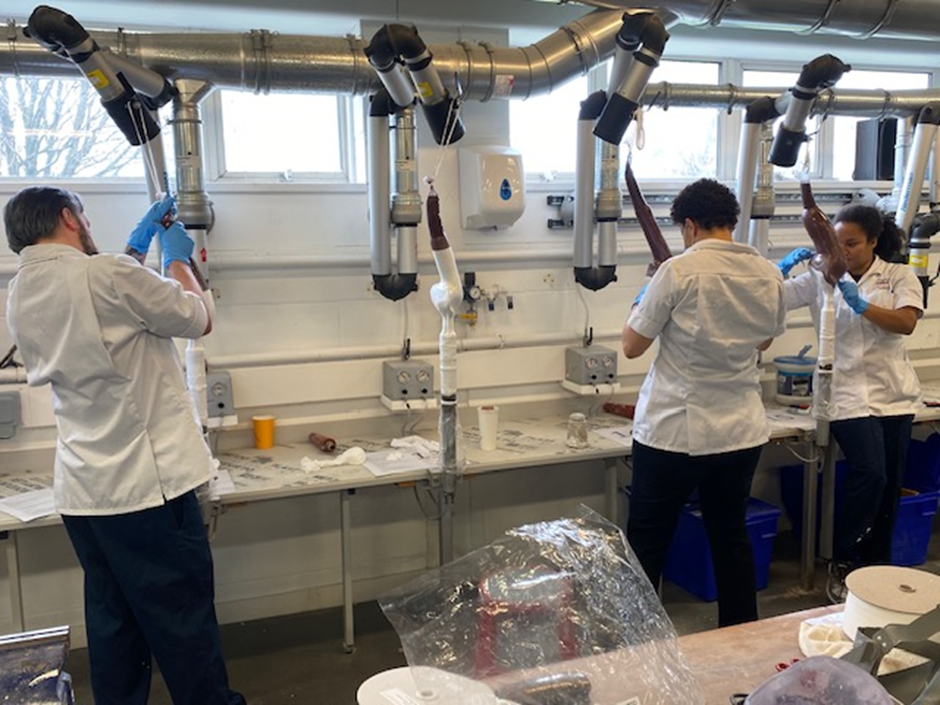
Figure 2: Students laminating the sockets
Impact:
Feedback has been overwhelmingly positive. Data gathered from learners on the second-year upper limb prosthetics module highlighted that 76% of students found the simulation effective/very effective in gaining insight into tailoring prosthetic solutions. 92% of learners also felt better prepared to treat service users following the experience. Learners also noted the importance of factors that influence prosthetic selection and rehabilitation, the significance of individual’s backstories and social factors and the need to focus on both physical and psycho-social needs (Table 1).
| Table 1: second-year upper limb prosthetics module learner feedback | |
| Learner 1 | “It has been a privilege being involved in the Uganda project…we haven’t actually met or seen the patients, so it has been tricky making a socket from a negative cast taken by someone else and sent through the post. We haven’t been able to make personalized adaptations during rectification and manufacturing like we normally would, but we are hoping the sockets will fit well and allow the ladies to do the things they want and need to do in their daily lives. Having this project alongside our module has taught me things that I might not have learnt as we have had to consider the very different resources and environment in Uganda to provide the best prescription. It has also been very rewarding contributing to a real patient’s life, and I look forward to hearing how the ladies get on with the socket fit and new devices”. |
| Learner 2 | “The simulation highlighted that all 3 service users are not the same, factors like activity level, occupation, cultural background, emotional readiness, and personal preferences all play a significant role in prosthetic selection and rehabilitation” |
| Learner 3 | “This has helped look at the backstory and social factors that each individual has and use that to provide better care rather than just look at the physical” |
| Learner 4 | “[I am] more aware of impact of supplies and awareness of mindset towards disabilities and acceptance of harm” |
This authentic simulated virtual experience has allowed opportunity during the module to discuss themes related to international awareness, global citizenship, supply chain issues and costs, domestic violence and the inequalities in healthcare. Learners have gained valuable global insight, and the impact on the service users will be potentially life changing.
Next steps:
Initial feedback was that the service users were very pleased with the cosmetic appearance. K4C are getting them some training with the limbs so they can utilise them as best as possible for their activities of daily living, we are hoping to get further feedback soon on how this has gone and the impact the new limbs are having on their lives.
Get in touch
If you want to know more about this, get in touch!
Share this page
Other resources
Work with us
Collaboration
The Council collaborates with education providers, charities, government organisations and arms-length bodies, healthcare providers, and professional bodies to enhance healthcare education and workforce development.
Funding projects
The Council has worked with a number of external organisations who have funded specific projects. We are open to exploring opportunities that the Council is uniquely placed to deliver and that support the work of the Council and its members.
Memorandum of understanding
The Council uses memoranda of understanding with external organisations and networks to support collaboration on areas of mutual interest.
Supporting bids
The Council is open to working with members and stakeholder organisations to support bids for externally funded projects.