


In this blog, Priya Anand, Assistant Professor at the University of Bradford, reflects on a new placement approach which she developed whilst on a secondment with the West Yorkshire AHP Faculty.
As AHPs, we are essential contributors to preventative health and patient/person-centred outcomes across the health and social care sectors. However, the ever-increasing demand for AHPs, as highlighted by the need to increase student numbers, places immense pressure on traditional placement models.
As an AHP Practice Learning and Development Lead and Assistant Professor of Physiotherapy, I’ve seen first-hand the pressure on traditional placement models. The NHS England 10-Year Plan calls for three strategic shifts. To meet these priorities, we needed a model that expands placement capacity, promotes preventative care, and prepares students for integrated systems.
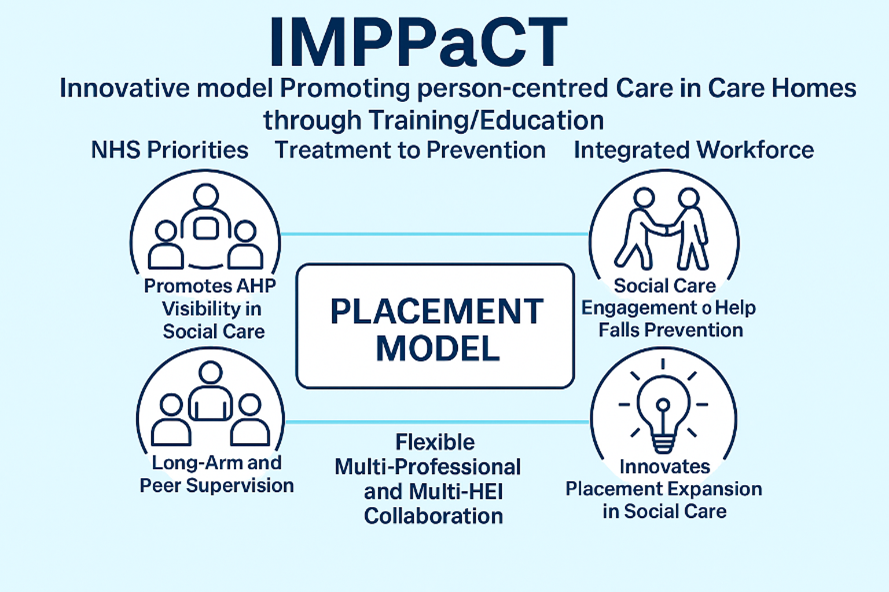
That’s why I developed the Innovative Model Promoting Patient/Person-Centred Care in Care Homes Through Training/Education (IMPPaCT).
The Need for Placement Innovation
IMPPaCT introduces non-traditional, community-based placements in care homes-settings often overlooked but rich in learning opportunities. This approach not only increases capacity but also equips students with skills for integrated care systems and preventative health strategies.
What Makes IMPPaCT Different
Meeting the NHS Strategic Shifts: It is designed to meet the three crucial strategic shifts outlined in the NHS England 10 Year Plan.
- Hospital to Community and Integrating Preventative Care: The model places AHP students in care home settings, shifting the focus of care and learning closer to where people live. It is centred on preventative interventions, such as falls prevention and nutrition.
Multi-professional Approach: By incorporating different AHP professions to provide advice and collaborate on education, the model equips students to understand the scope of practice for other professions and fosters interprofessional collaboration.
Training and Education for Care Staff: This training is crucial for several reasons:
- Enhances Competence and Holistic Care: It supports care staff retention and helps them develop an understanding of holistic care.
- Mitigates Liability and Contributes to Quality: Enhancing staff competence mitigates liability by ensuring they are well-educated, and it helps in contributing towards the CQC quality assurance targets.
Achieving Sustainable Placements and AHP Visibility
The model’s operational framework helps overcome barriers to sustainable placement development while elevating the profile of AHPs in social care:
- Embedding the Pillars of Practice: The model integrates the four pillars of practice ensuring students engage in holistic professional development beyond a purely clinical focus.
- Structured Supervision: The implementation of Peer Supervision and Long-Arm Supervision provides robust support while making supervision models more flexible and sustainable for care settings.
- Enhancing AHP Visibility: By having students co-create practical, evidence-based toolkits and lead education sessions for care staff, the model clearly highlights AHPs as vital contributors to preventative health in social care.
The Impact so far
- 525+ placement hours delivered
- 30+ care staff trained
- 3 HEIs involved
- 100% care staff satisfaction
Feedback from care staff highlights increased confidence in managing falls, while students report improved leadership, education, and research skills—competencies often hard to develop in traditional clinical settings.
I would like to share an inspirational video beautifully summarising students experience on this placement.
As we look to the future, plans include scaling IMPPaCT across multiple regions and integrating more AHP disciplines to continue building a resilient, skilled, and visible AHP workforce.
Related links
Get in touch
If you want to know more about this, get in touch!
Share this page
Other blogs

Race Equity Month – Navigating Racism from Both Sides: A Student Reflection on Peer Support and Inclusivity
A guest blog from Divanshi Sharma, Nursing Adult Student from the University of Roehampton. Divanshi is also a…
Domain 1: Responsibility and Accountability
All members of the AHP community need to be aware of the competencies required for their role as an…
Domain 2: Diverse and Inclusive leadership
Respect for the diversity of learners is at the core of educator practice. A commitment to developing equitable…
Domain 3: Community and Co-production
Co-creating learning opportunities and ensuring that the voices of learners and the end users of any service are…
Work with us
Collaboration
The Council collaborates with education providers, charities, government organisations and arms-length bodies, healthcare providers, and professional bodies to enhance healthcare education and workforce development.
Funding projects
The Council has worked with a number of external organisations who have funded specific projects. We are open to exploring opportunities that the Council is uniquely placed to deliver and that support the work of the Council and its members.
Memorandum of understanding
The Council uses memoranda of understanding with external organisations and networks to support collaboration on areas of mutual interest.
Supporting bids
The Council is open to working with members and stakeholder organisations to support bids for externally funded projects.