


Introduction
Let’s be blunt: hearing “this doesn’t feel like dyslexia” doesn’t feel like praise. It feels like assumptions being cast in a manner to discredit or devalue lived experiences. It’s a statement that shrugs off the process behind the product. Before we celebrate a polished end-point, let’s raise the curtain on the journey. Because dyslexia is not just a quirk in spelling, grammar and punctuation – it is a lived, wired difference in processing language, cognition, working memory, and more.
As someone who is openly dyslexic, autistic, and ADHD‑neurodivergent, I know too well how assumptions about what dyslexia “looks like” lead to harm, misunderstanding, and exclusion. My aim is simple: to offer insights to refocus lenses, shift assumptions, and invite you into how the higher education sector must respond during a time of incredible challenge: ethically, thoughtfully, and equitably.
Dyslexia: beyond reading and writing
Dyslexia manifests in multiple ways, some of which include:
- Phonological / auditory processing: difficulty with verbal instructions, multi-step spoken commands, or rapid information processing.
- Working memory and sequencing: juggling multiple elements in order, retaining elements while processing further elements.
- Naming, retrieval speed, orthographic mapping: the speed at which one retrieves words, or matches sound to symbol.
- Visual processing / spatial‑symbol integration: sometimes in how one visualises or organises text or symbols.
- Executive functioning overlap: planning, organising, shifting, initiation, persistence (challenges commonly experienced in many neurodivergent individuals).
Because of this, a person may write well, yet struggle to follow a chain of spoken instructions, or reverse steps, or they may mis‑map how they are recording what they heard. It is not a “writing problem” alone. It is a language processing difference that seeps into how one thinks, rehearses, expresses, edits, and responds – verbally and in writing.
A myth I often confront: “If they can write fine, they can’t have dyslexia.” That’s false. Some dyslexic people develop compensatory strategies or exceptions in certain modes. But that doesn’t mean the underlying challenges disappear – they often persist or amplify in contexts of cognitive load, fatigue, or ambiguity.
Dyslexia also often walks alongside or close to autism, ADHD, and dyspraxia. The same neuro-cognitive wiring that distributes processing differently can create strengths (pattern recognition, divergent thinking, holistic sense‑making) and challenges (executive load, time processing, sensory overload). Seeing dyslexia in isolation is often a disservice, and focusing only on specific day-to-day challenges to form assumptions could be viewed as bordering on neglect.
A hidden shift: 2025 DSA support changes and who is impacted
Readers may or may not already know: from 17 March 2025, disabled students no longer qualify for UK Disabled Students’ Allowances (DSA) support covering “basic” spelling, grammar and punctuation.
That change disproportionately impacts dyslexic learners, who typically rely on such support, as well as many disabled students for whom English is an additional language.
Removing this support is not a neutral change – these are the students whose equity in assessment, communication, and expression were previously supported.
In effect, the policy shift shifts burden back onto the student or their education provider to compensate – without necessarily providing the time, resources, training, or awareness to do so.
Where Equality Impact Assessment (EIA) and decision‑making often falls short
When policies or practices move to remove or reduce support, we must ask: whose voices were centred in the impact assessment?
Too often, those most affected – in this instance dyslexic learners, multilingual learners, specialist support practitioners – are not meaningfully consulted. The result: blind spots, unintended consequences, and marginalisation.
In my work preparing an evidence-based response to this change in support for disabled learners, I was able to show how some assessments treat disabled learners as homogenous, or only examine narrow metrics (e.g. cost savings, overall headcounts) rather than intersectional effects (how the change affects e.g. rural learners, multilingual dyslexics, socioeconomically disadvantaged students, carers) or valuing the group(s) most affected as their own independent groups – or even subgroups – and not just a “small percentage” of a broader definition “disabled students”.
Organisations – and not only in the education sector – must rethink EIA design: start by centring voices of those most likely to be marginalised by a decision, not retrofitting mitigation afterwards.
What higher education (HE) providers can do (and are doing)
Even where policy changes impose constraints, HE providers can act as mitigators and advocates:
Review internal mitigation policies – e.g. provide writing aids, explore access to current software provisions, create spelling/grammar support and share this with other HE providers.
Embed awareness training for staff (academic, admissions, support) about dyslexia as language processing challenges, not just spelling errors – thus reducing the emotional demand placed on students to relive their experiences in order to convince a person or committee that they need the support they had always been in receipt of before the decision earlier this year.
Be part of the conversation – sign up to the UK Disabled Student Commitment to signal that your institution will act proactively, not passively: you won’t be alone, with 30 UK organisations already signed up, and happy to advise and support your signing up.
Partner with organisations — bodies such as NADP and BATA (British Assistive Technology Association) are working tirelessly behind the scenes to reopen discussion tables, advocate for reinstatement, and share best practice: reach out, advocate for your students, and explore how real change and progress can become a reality when we implement models of co-design and valued contributions from disabled students.
Intersectionality, inequity, and the opportunity
Policy changes rarely affect everyone equally, and there are many additional confounding factors that need to be considered, for example:
- A student who is dyslexic and comes from a low-income background may lack capacity to self-fund alternative supports in response to their support being withdrawn.
- A dyslexic student whose first language is not English may struggle disproportionately when a form of support is framed as “basic” without their needs being used as the frame of reference for measurement in that framing.
- Students from underrepresented socio‑demographic groups may have disproportionate social capital or previous experiences of how to fight for exceptions or adjustments.
Closing: a call to mind and action
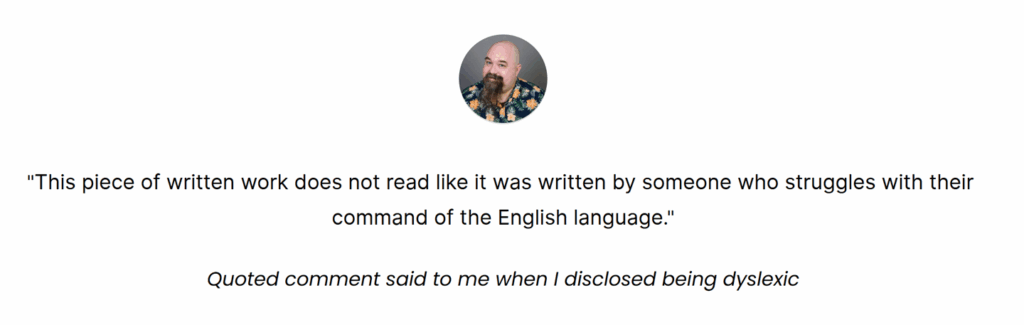
I return to that initial quote from almost a decade ago:
“This piece of written work does not read like it was written by someone who struggles with their command of the English language.”
And I am fortunate (and yes even a little proud) to now reflect on how I “caged the emotional beast”, by pausing before calmly responding:
“You are viewing the destination, not the journey.”
What we have in front of us is an opportunity – perhaps even a responsibility to rethink and redesign equality impact assessments and policy review processes so that the margins become the benchmark, not the afterthought.
Let us not mistake the smooth finishing line for erasing the toil along the way. For dyslexic learners, the journey is full of hidden negotiations – of memory, reshuffling, trial, review, and recovery. When we only see the destination, we disbelieve or de‑legitimise that labour in the journey.
During Equity month 2025, I invite the Council of Deans of Health audience to:
- Look deeper into policy shifts and how they distribute burdens unevenly.
- Insist on inclusion in equality impact assessment design from the start.
- Embrace institutional responsibility to mitigate where any internal or external policy changes harm equity.
- Use signposted practices and commitments to centre disabled student voices.
- Recognise that supporting dyslexic learners is not about charity – it is about ensuring educational justice.
Finally, please remember signing up to the UK Disabled Student Commitment is not just symbolic – it gives disabled students the messages they depend on when making decisions to choose their education provider, and it signals institutional accountability.
AI-Transparency statement: The author used a Generative Artificial Intelligence (GenAI) tool to assist in the preparation of this blog article, but reviewed and commits to every word of it – holding themselves accountable for the content, and ensuring the views expressed within are their own and not necessarily those shared by any individuals or organisations they are associated or affiliated with.
Related links
Get in touch
If you want to know more about this, get in touch!
Share this page
Other blogs

Race Equity Month – Navigating Racism from Both Sides: A Student Reflection on Peer Support and Inclusivity
A guest blog from Divanshi Sharma, Nursing Adult Student from the University of Roehampton. Divanshi is also a…
Domain 1: Responsibility and Accountability
All members of the AHP community need to be aware of the competencies required for their role as an…
Domain 2: Diverse and Inclusive leadership
Respect for the diversity of learners is at the core of educator practice. A commitment to developing equitable…
Domain 3: Community and Co-production
Co-creating learning opportunities and ensuring that the voices of learners and the end users of any service are…
Work with us
Collaboration
The Council collaborates with education providers, charities, government organisations and arms-length bodies, healthcare providers, and professional bodies to enhance healthcare education and workforce development.
Funding projects
The Council has worked with a number of external organisations who have funded specific projects. We are open to exploring opportunities that the Council is uniquely placed to deliver and that support the work of the Council and its members.
Memorandum of understanding
The Council uses memoranda of understanding with external organisations and networks to support collaboration on areas of mutual interest.
Supporting bids
The Council is open to working with members and stakeholder organisations to support bids for externally funded projects.